NYT Games, Ranked
From Strands to Spelling Bee, my favorite games from the Times
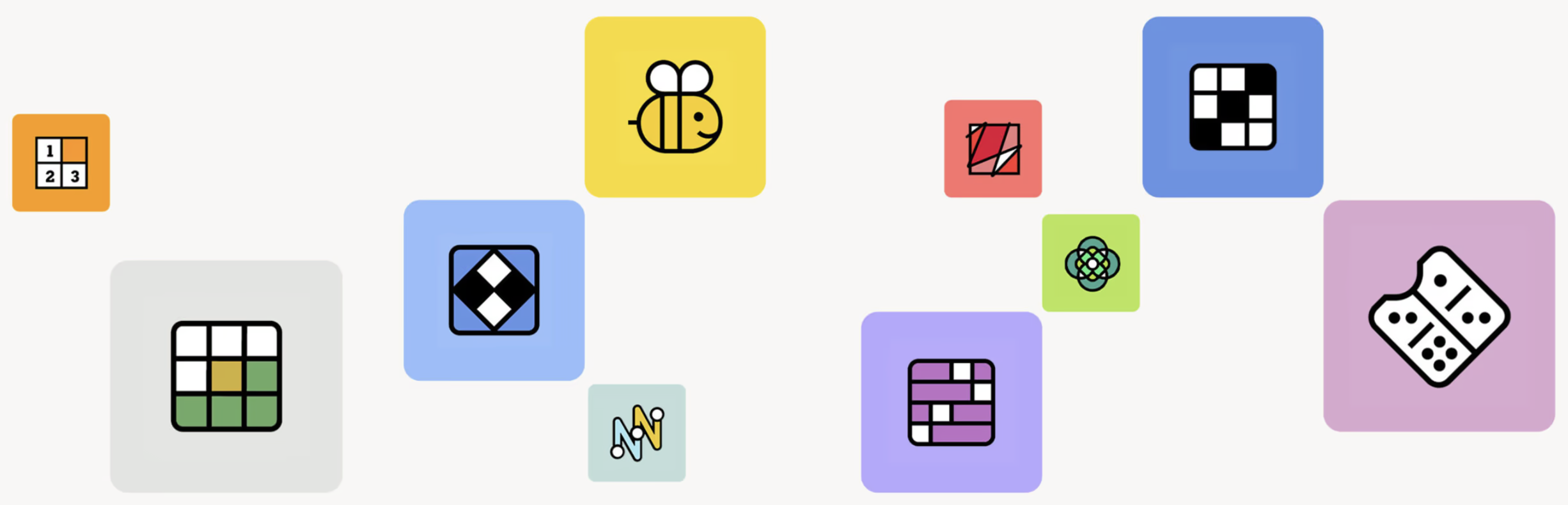
There are a lot of NYT Games to choose from. From the get-go, I’ll say it’s a great lineup. Many offerings present a simple idea that has a lot of possibility for creative play. But I certainly have my favorites. Here’s a look at how I’d rank them.
#10: Letter Boxed ❤️
Create words using letters around the square
This puzzle fits the mold of a simple idea with a surprising amount of complexity. But in this case, Letter Boxed can come at you with too much complexity. Like Spelling Bee, you create words, but you use up your bank of available letters. This leads to a lot of dead ends, and if you want to try to improve your showing, you typically have to remove all your guesses and start over. It’s fun to find connections between words, but the constraints end up tying themselves in knots with too many cases of failed paths. The win condition is very forgiving, but the mechanics feel hard to master, such as drawing within the box and creating longer word chains. A simple premise, but a challenge for me to play with any regularity.
#9: Tiles 💚
Match elements and keep your chain going
Tiles is more about a relaxed feeling than a satisfying solve, clicking between cells to remove similar components. It is an enjoyable experience, but I don’t feel very clever solving it. It is very algorithmic, authored just by the style of the tiles. The zen mode is a nice way to pass some time, but it doesn’t feel like you are solving something. One way to possibly spruce it up would be to theme the tiles for certain events during the year. It remains a fun idea, but its joy to play wanes after a few attempts.
#8: Sudoku 🔢
Try this numbers game, minus the math
It is almost a requirement to have Sudoku as a playable game. It has staying power because it is simple to explain while still offering a robust challenge. It has a tendency to feel very algorithmic, but there are ways to create an authored Sudoku. For example, mirrored and rotated starting numbers is a nice touch, making it feel like every puzzle is a little more special. The standard Sudoku satisfies, though there are other puzzles that allow for more creative solving experiences.
#7: Wordle 🟩🟨⬜️
Get 6 chances to guess a 5-letter word
Wordle is riding a surge of popularity from its simple premise and flawless execution, coupled with a great way to share results. The sharing mechanic became so popular, most other puzzles find a way to incorporate it. Wordle is very bite-sized and approachable. There is the danger of losing, but that can be an asset rather than a liability. That said, the variety of what can happen in a given puzzle is more limited than other offerings. It doesn’t attempt to be too complex, but because of this reliance on simplicity, it ends up lower on my list. Regardless, it remains an addictive addition to any daily puzzling routine.
#6: Pips 🁬
Place every domino in the right spot
Pips is the newest offering for the Times, and it is a slight departure. Its introduction led NYT Games to restate their header text to include logic games as a focus. It is simple to explain, but has a lot to offer. The authorship is very prevalent, though less overt than some word-based games. Here, having a satisfying logical progression without words is an impressive result. The thing that takes it further is the possibility for authorship in unexpected ways, such as the shape the dominoes create, and using a set of three puzzles each day, similar to Sudoku, to create a larger narrative of some kind (spelling out LOVE for example). It is these small easter eggs for repeat solvers that makes it a solid addition.
#5: Spelling Bee 🐝
How many words can you make with 7 letters?
Spelling Bee is an interesting puzzle since it is incredibly simple, but hides a lot of complexity. Receive a set of letters each day, where one letter must be used. Add a word length requirement, and we’re off. I find it fun, but a little too open-ended and unconstrained for my tastes. It can be authored in subtle ways, like through pangrams, though construction can take some effort to limit possibilities. I find it is one of the few puzzles that really encourages returning to it throughout the day. I prefer to play with the Spelling Bee Buddy, which allows me to better fill in missing words using different methods. That said, on its own, it is a simple idea, executed beautifully.
#4: Connections 🟨🟩🟦🟪
Find groups of four items that share something in common
Group the words together. How hard could it be? Actually, often quite challenging! With so many double meanings or ways of interpreting the groupings, Connections presents a lovely challenge each day. It is also one of the offerings where you can explicitly fail, running out of incorrect guesses. This can discourage solvers, though it does introduce some stakes to your solve, similar to Wordle. Like the high-rated games on this list, Connections has a lot of opportunities for authorship, such as playful grouping tactics (substrings, rhymes, trivia), and can also break its own norms such as the tendency to have a picture/emoji-based puzzle on April 1st. Though its reliance on gotchas and wordplay may turn some solvers off, Connections is a fantastic puzzle.
#3: Strands 🔵🟡
Find hidden words and uncover the day’s theme
A newer offering, Strands is like a constrained word search. With a fun mechanic of a “spangram” and themed entries, the grid’s incremental fill leads to a pleasant solving experience. However, this puzzle does present opportunities for getting stuck. If you don’t get the theme of the day, it can be very impenetrable without hints. Strands can become frustrating if you don’t “get the joke”, as it were. However, after a few play-throughs, Strands reveals a lot of fun mechanics, such as splitting the grid into sections and giving nods to the shapes the words form. Like Connections, Strands provides a lot of creative play within a simple daily grid.
#2: Mini ✏️
Solve in seconds
The Mini does an excellent job at providing the crossword experience in a more compact form factor. There still remains a large space for having the author of the puzzle shine through with inventive cluing. There are a lot of opportunities to play with the form while still keeping things approachable. Though it is mini, it is mighty.
#1: Crossword ✒️
Fill the grid
The classic Crossword takes the top spot for a reason. With a larger grid, there are more possibilities for authorship and new fun mechanics. While crosswords have their own unique language quirks, there are ample ways to get a toe-hold. A puzzle becomes the most interesting when it dances around its own constraints. Crosswords are able to accomplish this simply with clue variation, but can go even further changing the grid organization, utilizing wordplay and rebuses, and much more. It is a beautiful puzzle to play.
Outro
In my view, the best games often have:
- Deceptively simple mechanics
- Places for inventive construction
- Strong feelings of puzzle authorship
- Joyful ways to share with others
It is impressive how the games at the Times are able to satisfy, day after day.
Happy solving!
Photo is from The New York Times Company